
The Gospel of Thomas
In the Gospel of Thomas Jesus recognises everyone and everything as facets of a single underlying Unity. He calls this cosmic wholeness the 'Living One'. In this unitive perspective we are charcterised by our sameness.
The early Jesus movement was factionalised and chaotic. In the first few centuries after Jesus's death there were multiple groups holding different views and perspectives regarding who Jesus was, and what his message meant. The Gospel of Thomas introduces us to a Jesus who advocates oneness. A Jesus who tells us that the Divine lives in the All of Everything
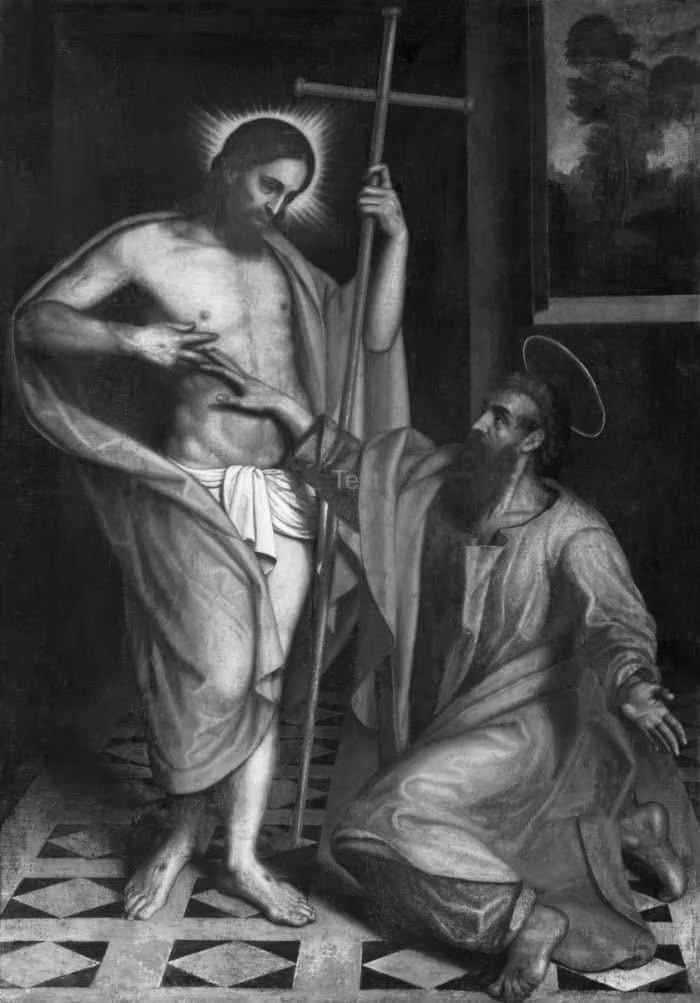
The Apostle Thomas
History knows Thomas as the 'Doubter', the one who needs to feel and touch the wounds of Jesus before believing. And yet here we have a gospel that positions him as the brightest and most insightful of Jesus's followers.
Gospel of Thomas – Introduction, History & Key Themes
The Gospel of Thomas is one of the most intriguing early Christian texts. Unlike the four canonical gospels, it presents no narrative of Jesus’ birth, life, death, or resurrection. Instead, it gathers 114 sayings of Jesus – some familiar, some unique, and many deeply mystical – offering an alternative perspective on early Christian spirituality and Unitivism. This introduction to the Gospel of Thomas explores its history, why it is not in the Bible, its key themes, and the nature of its sayings.
What Is the Gospel of Thomas?
The Gospel of Thomas is a collection of sayings attributed to Jesus, transmitted in the voice of “Didymus Judas Thomas.” It is often described as a “sayings gospel” because it contains almost no narrative. Each saying, or logion, is numbered and presented as a short, often enigmatic teaching. Scholars generally date the core of the Gospel of Thomas to the early second century, though I advocate for an earlier date. About half of its sayings parallel those in Matthew, Mark and Luke, with the other half being new and altogether different.
History of the Gospel of Thomas
The text of the Gospel of Thomas was lost for 1600 years. It was rediscovered in 1945 near Nag Hammadi in Upper Egypt, when local villagers uncovered a sealed jar containing ancient manuscripts now known as the Nag Hammadi Library.
Among these manuscripts was a Coptic translation of the Gospel of Thomas, copied in the 4th century. Most scholars believe that this Coptic text is based on an earlier Greek original, fragments of which have also been found at Oxyrhynchus in Egypt..
Key Historical Points
- Discovered in 1945 as part of the Nag Hammadi Library in Egypt.
- Preserved in Coptic, likely translated from a Greek original.
- Dates to the First Century and potentially precedes the Synoptic Gospels
- Contains 114 sayings attributed to Jesus, about half of which parallel to the New Testament.
Why the Gospel of Thomas Is Not in the Bible
Many readers naturally ask why the Gospel of Thomas is not included in the New Testament. The answer lies in the complex process by which the early church formed the biblical canon and selected which gospels to recognise as authoritative.
1. No narrative of Jesus’ life or resurrection
The early church favoured gospels that told the story of Jesus’ life, death and resurrection. Thomas offers almost no biographical information. Its exclusive focus on sayings and teachings made it less suitable as a foundational narrative for the developing Christian tradition.
2. Jesus is not the Son of God
The gospel positions Jesus as no more divine than you or I. The suggestion that he is the unique Son of God is actually dismissed by Jesus himself
3. Jesus is not the atoning sacrifice
The idea that the life, death,, and resurrection of Jesus is the atoning sacrifice for the sins of humanity is not referenced. We cannot find right relationship with the Divine by simply accepting Jesus into our lives.
4. Emphasis on self-knowledge and the unitive sentiment
The Gospel of Thomas encourages us to venture inwards and to discover the Kingdom within and the Kingdom without.
Most early church leaders regarded Thomas as heretical and discounted. Some spent their whole lives trying to undermine it.
Main Themes in the Gospel of Thomas
Despite its exclusion from the Bible, the Gospel of Thomas remains a powerful and thought-provoking text. Several recurring themes run through its 114 sayings.
The Kingdom of God is both within and without
One of the most famous sayings from Thomas teaches that the Kingdom is not a a future apocalyptic but something that is here and that is now. The Kingdom is found when we recognise the sacred wholeness of all that is
Self-knowledge as the path to life
The text often links self-knowledge with salvation. To know oneself is to awaken to one’s true nature and relationship with the Living One. We are each facets of the whole
Paradox, symbols and the unity of opposites
The sayings frequently use paradoxical language – speaking of the first becoming last, the inside being like the outside, and light hidden in darkness. This symbolic style points to a deeper unity in opposites and invites contemplation rather than simple literal interpretation.
Jesus as revealer of hidden knowledge
In the Gospel of Thomas, Jesus appears primarily as a teacher and guide who unveils what is hidden. The sayings often begin with “Jesus said…”, emphasising his role as a revelatory source.
Why is the Gospel of Thomas relevant?
Thomas presents us with a fallible Jesus, a Jesus who openly declares that life is hard. He lives with the rest of us down and dirty in the difficulties of life. In the modern world, a new era of masculinity is arising where it’s okay for men to show emotion and to talk about how they feel. It seems to me that Jesus role models this for us in a way that resonates with the cultural norms of the twenty-first century. He declares that we can’t control the world and how the world reacts to us, what we can control is what we think, what we believe, and how we behave.
On this site you can explore my translation of the 114 sayings from the Gospel of Thomas, accompanied in some instances with supporting commentary, It seems to me that it is Jesus’s Unitive Experience sits at the heart of the gospel. The idea that ‘All is One’ can provide assistance both to us as individuals, and also in the great collective challenges of our time. It provides us with different answers, answers not readily found in the Abrahamic religions. If you are looking for something different drop me a message and I will send you an invite to one of my workshops